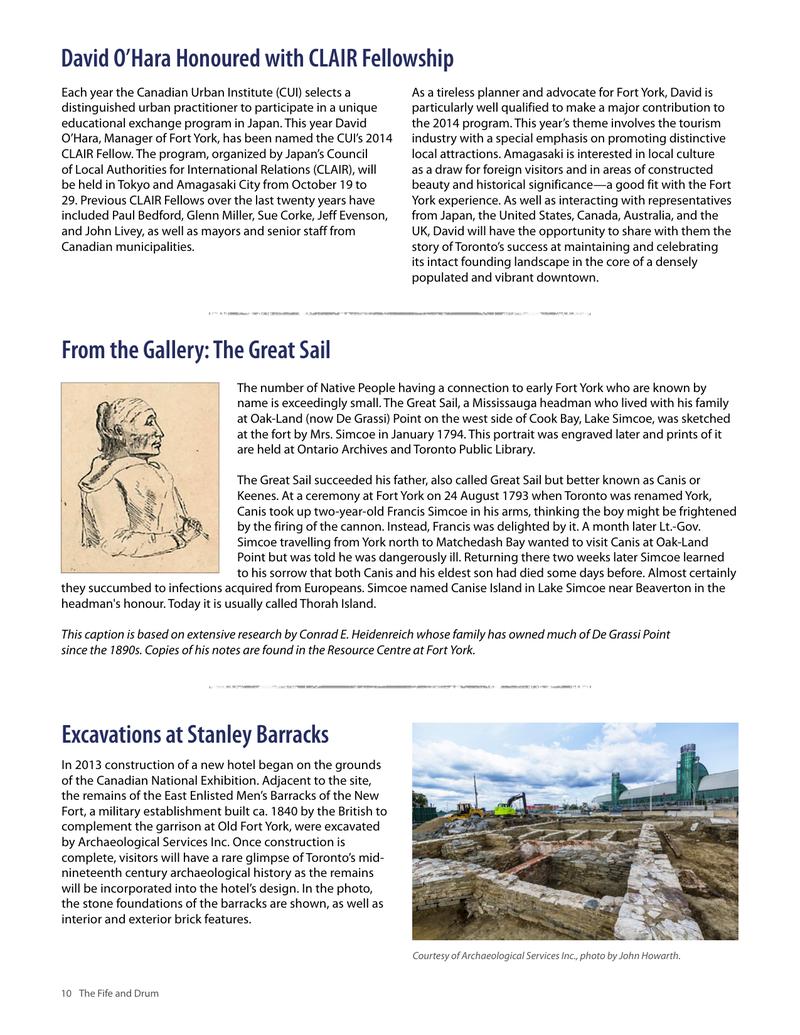
The number of Native People having a connection to early Fort York who are known by name is exceedingly small. The Great Sail, a Mississauga headman who lived with his family at Oak-Land (now De Grassi) Point on the west side of Cook Bay, Lake Simcoe, was sketched at the fort by Mrs. Simcoe in January 1794. This portrait was engraved later and prints of it are held at Ontario Archives and Toronto Public Library.
The Great Sail succeeded his father, also called Great Sail but better known as Canis or Keenes. At a ceremony at Fort York on 24 August 1793 when Toronto was renamed York, Canis took up two-year-old Francis Simcoe in his arms, thinking the boy might be frightened by the firing of the cannon. Instead, Francis was delighted by it. A month later Lt.-Gov. Simcoe travelling from York north to Matchedash Bay wanted to visit Canis at Oak-Land Point but was told he was dangerously ill. Returning there two weeks later Simcoe learned to his sorrow that both Canis and his eldest son had died some days before. Almost certainly they succumbed to infections acquired from Europeans. Simcoe named Canise Island in Lake Simcoe near Beaverton in the headman’s honour. Today it is usually called Thorah Island.
This caption is based on extensive research by Conrad E. Heidenreich whose family has owned much of De Grassi Point since the 1890s. Copies of his notes are found in the Resource Centre at Fort York.
Original printed pages